Home   Machine Tool Archive   Machine Tools For Sale & Wanted
E-MAIL   Tony@lathes.co.uk

Rivett 608 Lathe
High-definition 608 Photographs    608 and 8" Precision Accessories    608 Stands 
8" Precision Lathe   Nos. 3 & 4 Lathes   No. 5 Lathe   507 Precision Lathe   1020/1030 Toolroom Lathes
Rivett Home Page   Rivett Watchmakers' Lathes   Rivett Factory
A complete Instruction Book and Workshop Manual is available for the Rivett 608 - it covers much of the 8" Precision as well. Other interesting Rivett publications are also available.

Edward Rivett had a long background in the watch lathe and tool industry before he turned his hand to manufacturing larger precision machine tools. Born in 1851 near Montreal, in Canada, he took out his first patent (of around 30 to be registered in his name) in 1880 when he was working for C.A.W. Crosby, a successful Boston jeweller and watchmaker; this partner ship developed to the extent that, in 1884, the pair registered the Faneuil Watch Tool Company with Rivett as General Manager and Crosby as Treasurer. From a modest workshop the business expanded until it occupied a newly-built factory, 125 feet long and with 150 windows, overlooking the Charles River in Brighton, Boston. In 1890 the partners could see the opportunities in diversifying from a sole reliance on watch lathes and their associated tooling and began to expand their product range to include, first, the No. 4 Precision Bench Lathe, a made-to-order, 3-ton, three-spindle vertical-milling machine, then various grinders and other sizes of bench lathe, including the No. 3 and No. 4  and the wonderful  8-inch Precision. In 1903, to (partially) reflect the company's change of direction, it was named the Rivett Lathe Manufacturing Co..
In 1908 business had been good enough to double the size of the factory, but four years later Edward Rivett retired, selling his concern to a group of investors who renamed it
The Rivett Lathe and Grinder Company. In the build-up to World War 1 the new owners enjoyed a good return on their money, with production steadily increasing and another factory extension added in 1915 - just a year after the War's start in Europe. Remarkably, the factory was extended again in 1920, at a time when all nations, especially the more advanced ones, were suffering a post-war slow-down. However, this optimism was short-lived, and by 1923, with the company's finances in trouble, a reorganisation took place which saw the name changed to The Rivett Lathe and Grinder Corporation. The company survived the Great Depression of the early 1930s, sometimes only making a handful of lathes each year, though no doubt sales of grinders, spare parts, sub-contract machining and commissions for one-off  high-precision machines all added to the balance sheet. At some point during the 1930s the company's name was again changed, almost certainly to reflect the uncertain times and give better legal; protection to the directors, to Rivett Lathe and Grinder Incorporated. World War 2 saw a vast increase  in output of both lathes and grinders, with not only a strong home demand, but also large export orders and "lend-lease" arrangements for the UK. The usual post-war depression again saw a drastic fall in demand for high-quality machine tools, although the company did go back to its roots and introduce a new design of watchmakers' lathe, the 1R or "Ball Bearing" Model; unfortunately, only five or six hundred were manufactured before the market was saturated. Hydraulic controls (which required the same skills to manufacture as precision machinery) were also added to the product line, together with a completely new design of toolroom lathe, the 1020.
The Rivett Company survived as a separate entity until 1966, when Applied Power Industries, makers of fluid drives, bought the company to obtain the rights to special hydraulic valves and control systems. The Rivett Company was then combined with a subsidiary of Applied power, the Dynex Company, to form Dynex-Rivett, which is still trading in Pewaukee, Wisconsin. The machine-tool side of Rivett was sold off to a maker of production drilling equipment, the Leland-Gifford Company of Worcester, Mass. Leland-Gifford were in turn bought by White Consolidated and the machine-tool part of the business transferred to one of their subsidiary companies, Fay-Scott in Dexter, Maine. It is highly probable - and very unfortunate - that the remains of the Rivett production machinery was buried in a Maine land-fill in the 1970s.
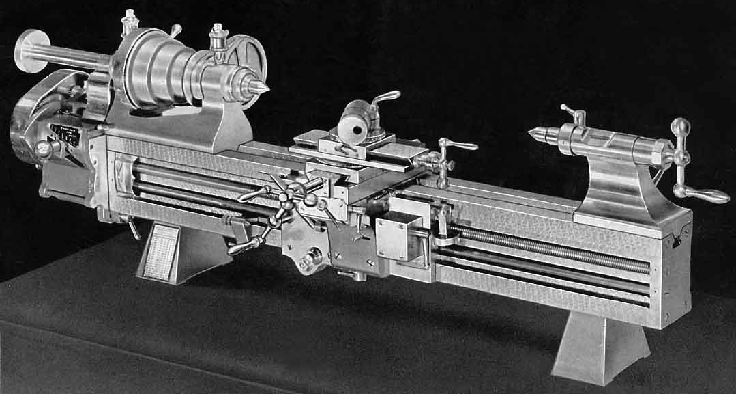
With a swing of 4.25" (a 9.5" lathe in American terms) and a maximum capacity of 21.25" between centres the 608 was a development of the original "8" Precision Lathe" of the late 1800s. It was, therefore, an ingeniously designed machine, exceptionally well made and beautifully finished - but, of course, so expensive that most of them found their way into the hands of the military, or Government research and development laboratories who, over the years, have proved themselves remarkably liberal when spending your money and mine. Certainly, some very well-preserved examples have come out of Official Reserve Stores over the years - and, who knows - there may be more left, lurking perhaps in some long-forgotten, dark corner of the Naval Procurement Office, Offshore, India Sub-region, Branch 7.
Equally famous in both the USA and the UK (many examples having been sent to Britain during WW2) a 608 in "civilian dress" would normally have glistened all-over in an imposing, fully-machined then hand-scraped and polished finish. It is amusing therefore to read, in the maker's wartime catalogue, a notice which apologised for the Government-imposed, "War Finish" (order L-108 from the U.S. War Production Board). Rivett certainly complied with the letter of this regulation, if not its spirit - they applied a coat of paint to the headstock and tailstock. In the early years of the 20th century the factory's master scraper (who brought the lathe to its final state of accuracy and alignment) was a Mr. Higgin - who recorded his involvement (unofficially) by scratching his name onto the back of the maker's labels.
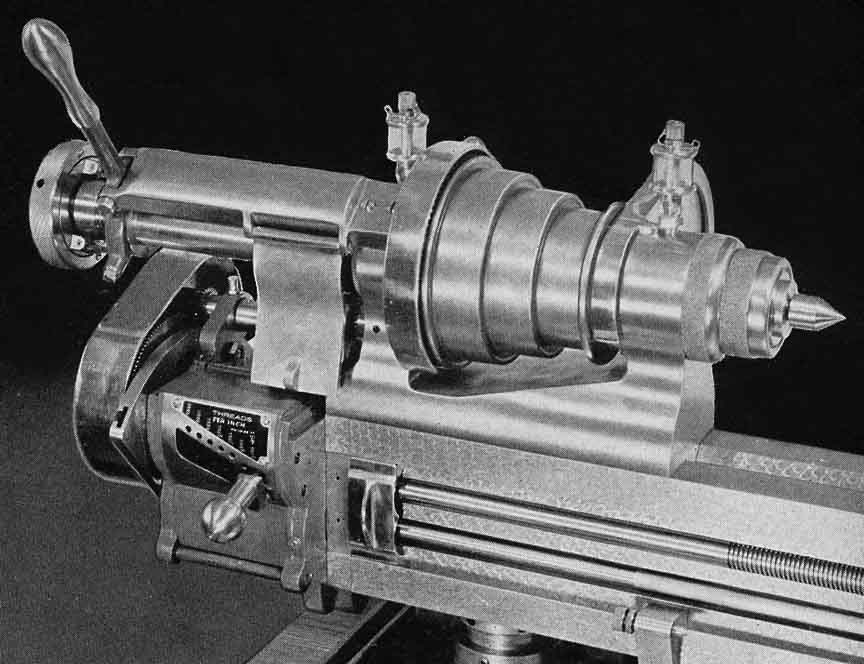
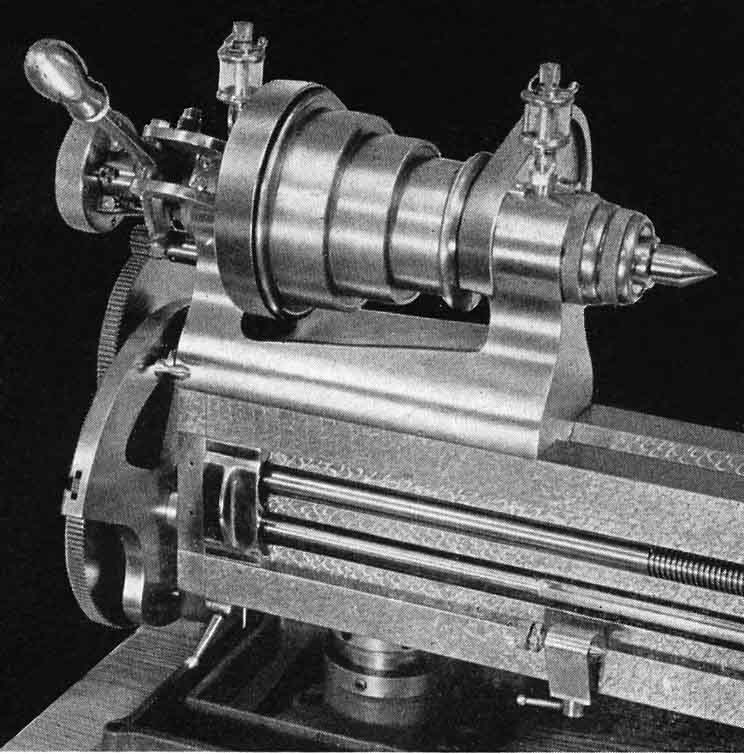
Available over the years in three types the headstock spindle changed thus: early ones, until some point in the 1920s, accepted 4NS collets with a maximum through capacity of 5/8". Later machines were offered with the option of what was to become the very popular 5C collet (in which latter case the maximum capacity increased to 1
1/16-inch) and finally, when V-belt drive was offered, the 5C spindle was adapted to become what the makers called the Type PV-5C. In all cases the spindle ran in massive phosphor-bronze bearings, which were fully adjustable for wear, with the edge of the drive pulley carrying a ring of 60 indexing holes. Maximum speed varied slightly over the years with the 4NS able to run to 1600 r.p.m., the 5C to 1295 r.p.m. and the PV-5C to 1500 r.p.m.
An entirely conventional backgear assembly was fitted, with engagement on an eccentric shaft, though there were differences in the arrangement on early and late models: lathes have been found with both 16DP and 18DP gears and headstock spindles carrying gears of 90 & 27 teeth or 90  & 38 teeth and backgears with 78 & 27 teeth or 68 & 27 teeth; all gears, as was common at the time, had a 14.5º pressure angle. The differences in the gearing arrangements on the headstock may be accounted for by the need to include a V rather than flat-belt pulley drive system - as well as on-going refinements to the mechanical specification.
The drive from headstock spindle to leadscrew was unusual: instead of a tumble reverse mechanism the Rivett employed a large gear, keyed to the spindle, that could be slid (by grasping a knurled ring on its outboard flange), into any one of three positions. Pushing the ring and gear to the right engaged a small intermediate gear that, driving through the gearbox or changewheels, caused the carriage to move towards the tailstock. In the gear's central position the drive was out of mesh and the carriage stopped whilst, logically enough, moving the gear to its left-hand position caused the carriage to move to the left, towards the headstock.
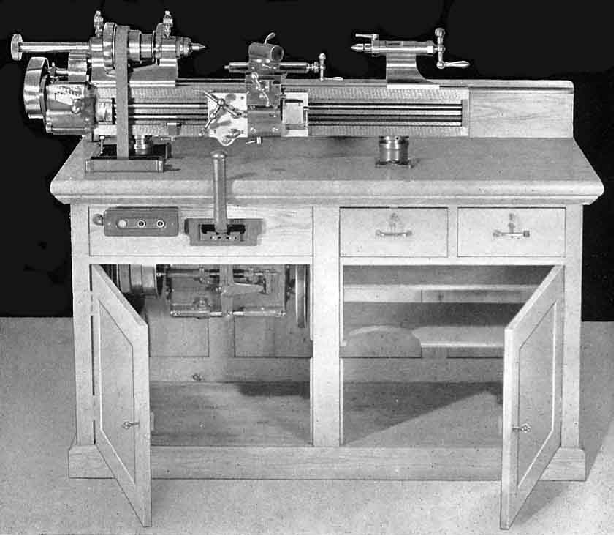
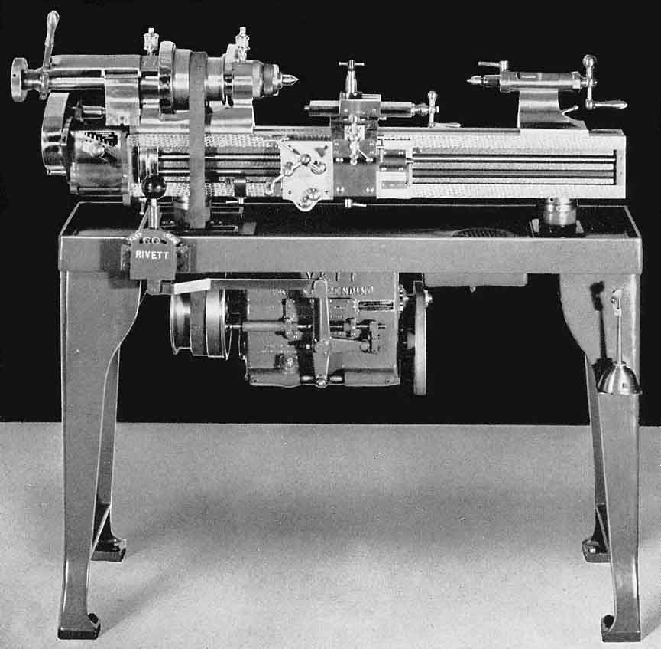
The 608 pictures below are all reasonably high-resolution images from the maker's catalog and take a little time to load; reproductions of this particularly fine publication are available.  More catalog pictures can be seen here
C
ontinued below:

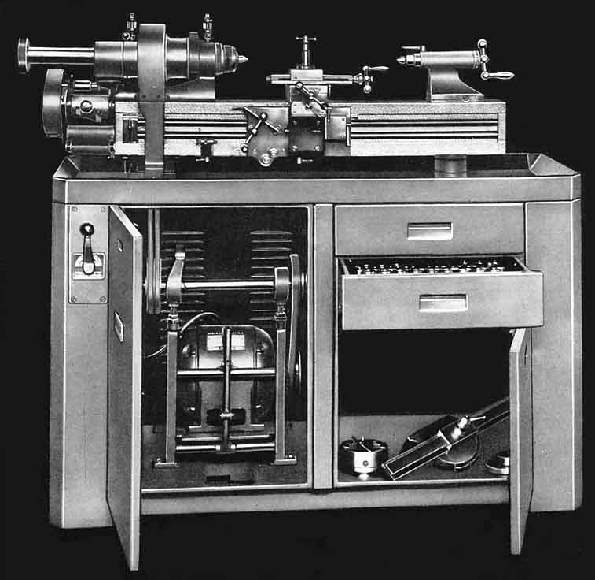
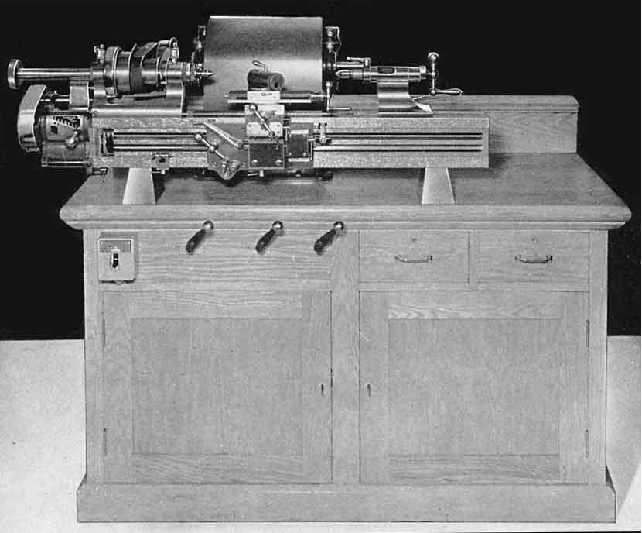
Rivett 608 precision lathe 4.5" x 18" as produced in the early 1940s. This particular model, on non-height-adjustable "pyramid" feet, was intended to be driven by a rear-mounted countershaft.
Continued:

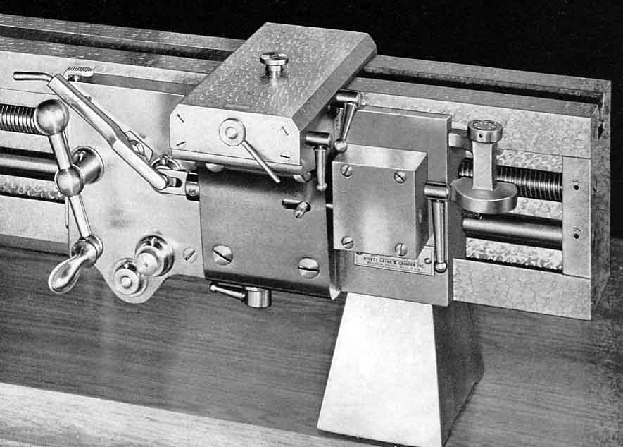
Most lathes use only the top face, and upper edges of their beds to guide the saddle, but on the Rivett the front face of the bed, formed into dovetails and plain ways, was used to support the apron as well. This resulted in a very stiff structure beneath the cutting tool and a saddle-to-bed bearing area of 74 square inches (the rare English Spencer lathe had a similar but inferior system - and the little Toyo precision lathe of the 1960/70s rejoiced in
twin aprons guided by both front and rear bed faces).
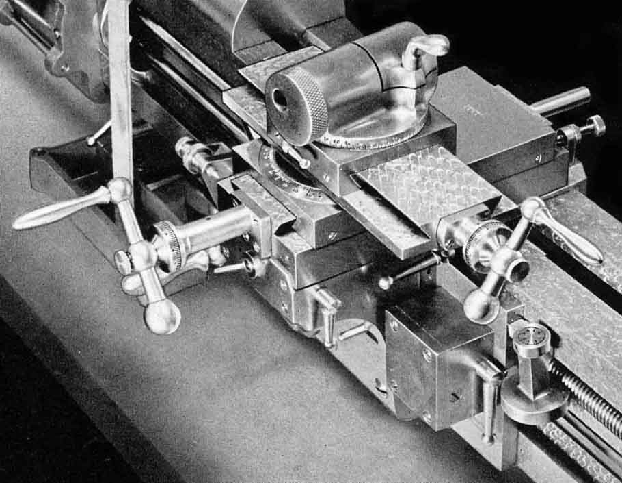
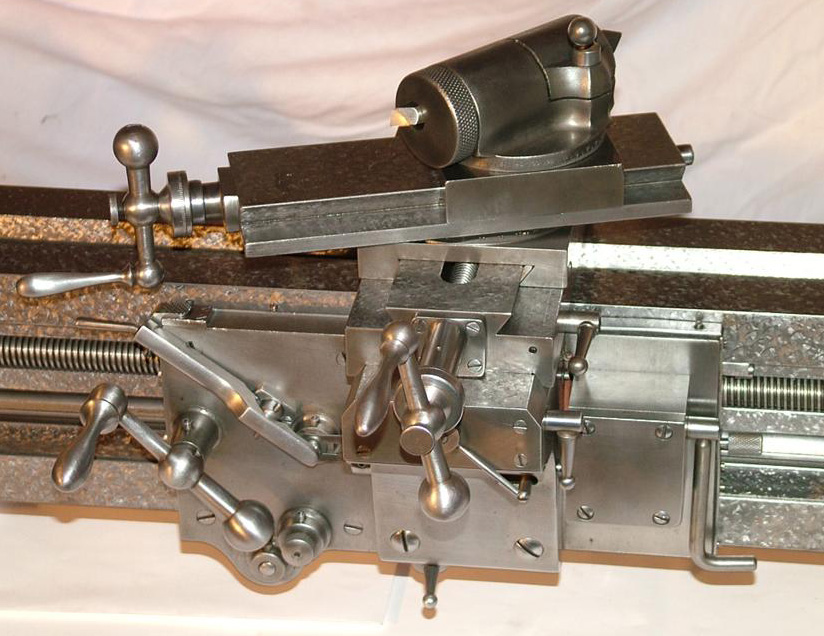
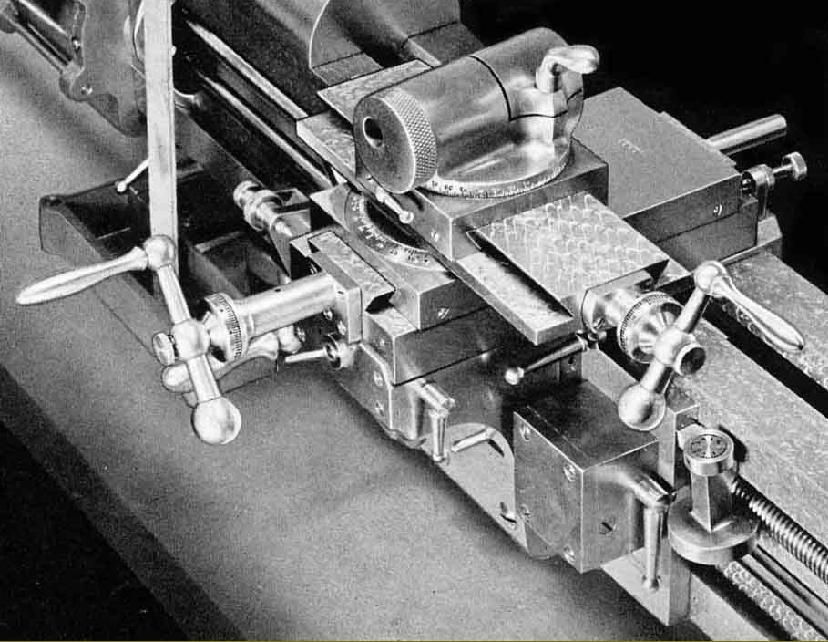
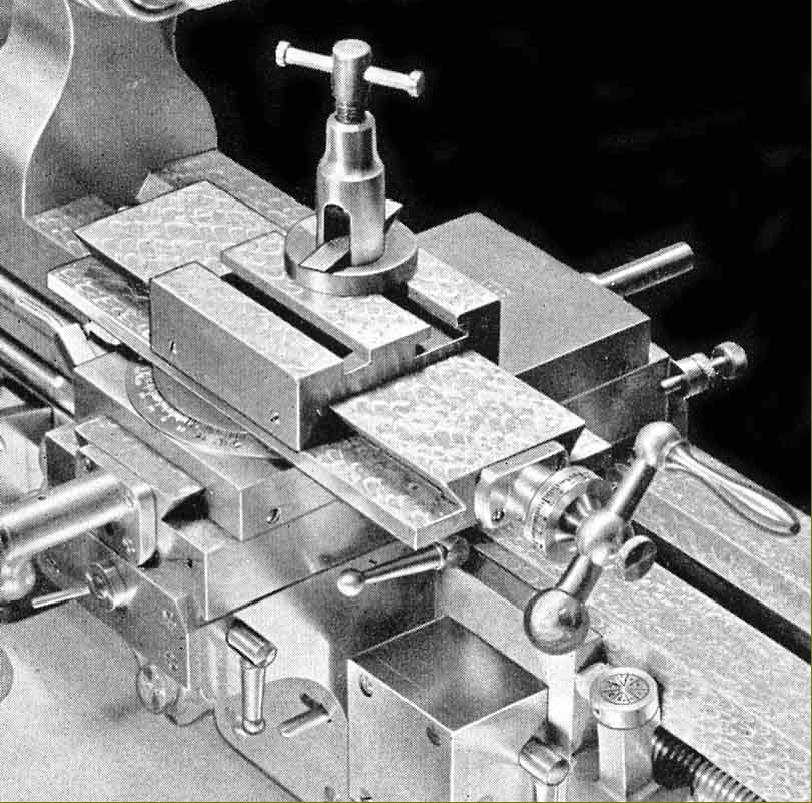
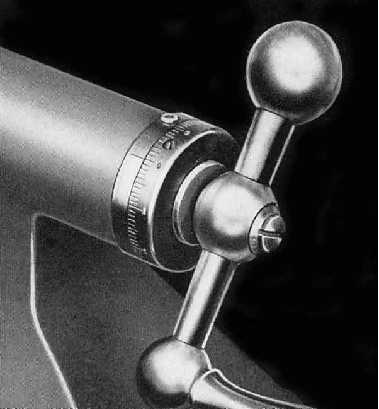
Beautifully constructed the compound slide rest worked with a silky-smoothness whilst the top slide, echoing the lathe's plain-turning ancestors from the latter part of the nineteenth century, had over 5" of travel. However, the micrometer dials, like those of its competitors were far too small, thjough they could be locked by a sensitive mechanism, controlled by a convenient thumb wheel (whose thread passed through the centre of the handwheel) and with no danger of disturbing the setting. The slide rest was retained by a clamping post that could be quickly released to allow repositioning or removal of the unit - a useful facility when using one of the many accessories designed to mount in its place.  The cross slide was fitted with power feed, but to use it the operator had to first move back a gear-guard cover and then ensure that the lower element of the cross slide was in its correct position (nearly flush with the edge of the apron) so as to pick up the lower apron-mounted drive gear.
Originally fitted with screwcutting by changewheels by the late 1920s the 608 could also be ordered with a quick-change screwcutting gearbox for either bench mounting or ready-fitted to variety of interesting stands with, originally, flat-belt drive and then, from around the mid 1930s, with V-belts. All 608 models were fitted with both a leadscrew and a power-shaft, so preserving the accuracy of the former when simple power sliding and surfacing feeds were required. The drive to the power-shaft was arranged, very simply, by a gear keyed to and sliding on the leadscrew which engaged a fixed gear beneath it on the power shaft; the two gears were covered by a rather elegant nickel-plated bronze cover which slid in groves on the face of the bed. An automatic-disengage mechanism was fitted to the carriage drive and this, with Rivett thoroughness, was fitted with a small micrometer dial and could be set to stop the cut to within 0.001". On its own the screwcutting gearbox could generate only a limited number of threads but supplied with the lathe were a set of changewheels, to mount on the standard quadrant bracket, to extend the threading range. Unusually, in order to accommodate a change of ratio, when the new changewheels were in place it was necessary to pivot the whole gearbox to mesh the train with the fixed drive gear above. The arrangement of the leadscrew was also novel; it was sunk into the front face of the bed with a good proportion of its rear section fitting very closely against the semi-circular channel in which it ran; this resulted in a well supported, flex-free shaft - but one where which only a portion of its front section was able to be engaged with the single half nut carried by the apron. The unusual bed design also caused another problem, the mounting of the rack needed to drive the carriage by hand feed: because of the very limited room the rack was held on by small screws passing vertically between the teeth every 3 inches or so - the screws are tiny and, should the rack require removing, great care is necessary to avoid damaging them. Some 608s appear to have had 7/64" by 48 t.p.i. screws (with smaller than standard heads) but other sizes could have been used over the years
On some forms of maker's stand the lathe bed, to prevent it being twisted by an uneven installation, was supported at the headstock end by placing a ball bearing under the front edge, and another under the rear - whilst a single ball was positioned in the middle of the bed at the tailstock end. Various forms of overhead auxiliary drive were also available, designed to power a range of grinding, traverse-milling, threading and drilling attachments, etc.
Unsurprisingly, the Rivett 608 has always been a highly sought-after machine - and one in good condition is capable not only of a wide variety of very accurate work but will provide a pride and delight in ownership that few other machine-tools can engender..

Typical of the well thought-out features included in the design of the Rivett 608 was the fact that no tools, apart from a chuck key, were required to operate it; a slender lever (it can be seen on the end of the cross-slide base) released the compound slide rest and it could then be instantly repositioned, or slipped off to be replaced by a variety of beautifully-made accessories including a vertical milling slide, hand-tool rest, saw table or indexing, slotting, ball-turning and relieving attachments.
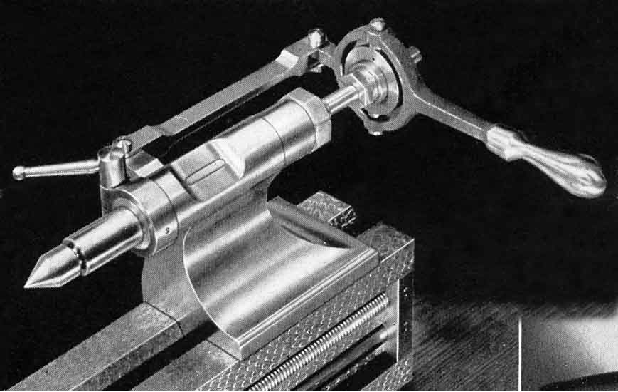
The leadscrew and power shaft were held in a plate, screwed and dowelled to the tailstock end of the bed; removing the plate allowed the complete carriage assembly to be slid off for cleaning or maintenance.

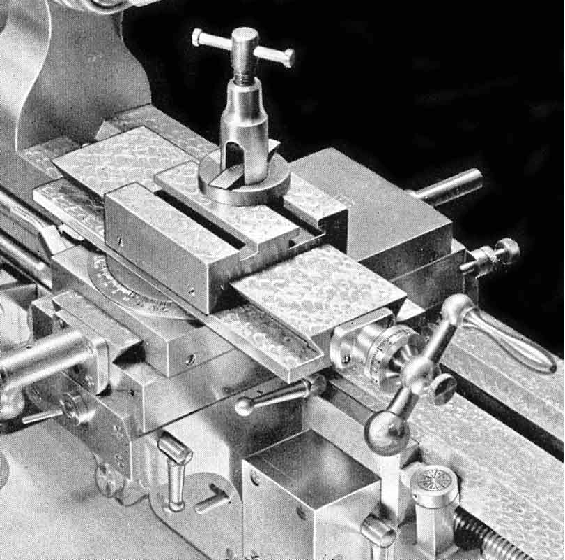
A variety of toolposts was offered including this design, first seen in the 1880s, where a round cutting tool was clamped into an lever-locked eccentric mount which could then be rotated to adjust the tool's height and rake. This type of toolpost appears to be the one fitted as standard to all 608s exported to the UK.
The compound slide rest was beautifully constructed and worked with a silky-smoothness; the top slide, echoing the lathe's plain-turning ancestors from the late part of the eighteenth century, had over 5" of movement. However, the standard micrometer dials, like those of all its competitors were far too small, but on the Rivett hey could be locked by a sensitive mechanism, controlled by a convenient thumb wheel with no danger of disturbing the setting.