|
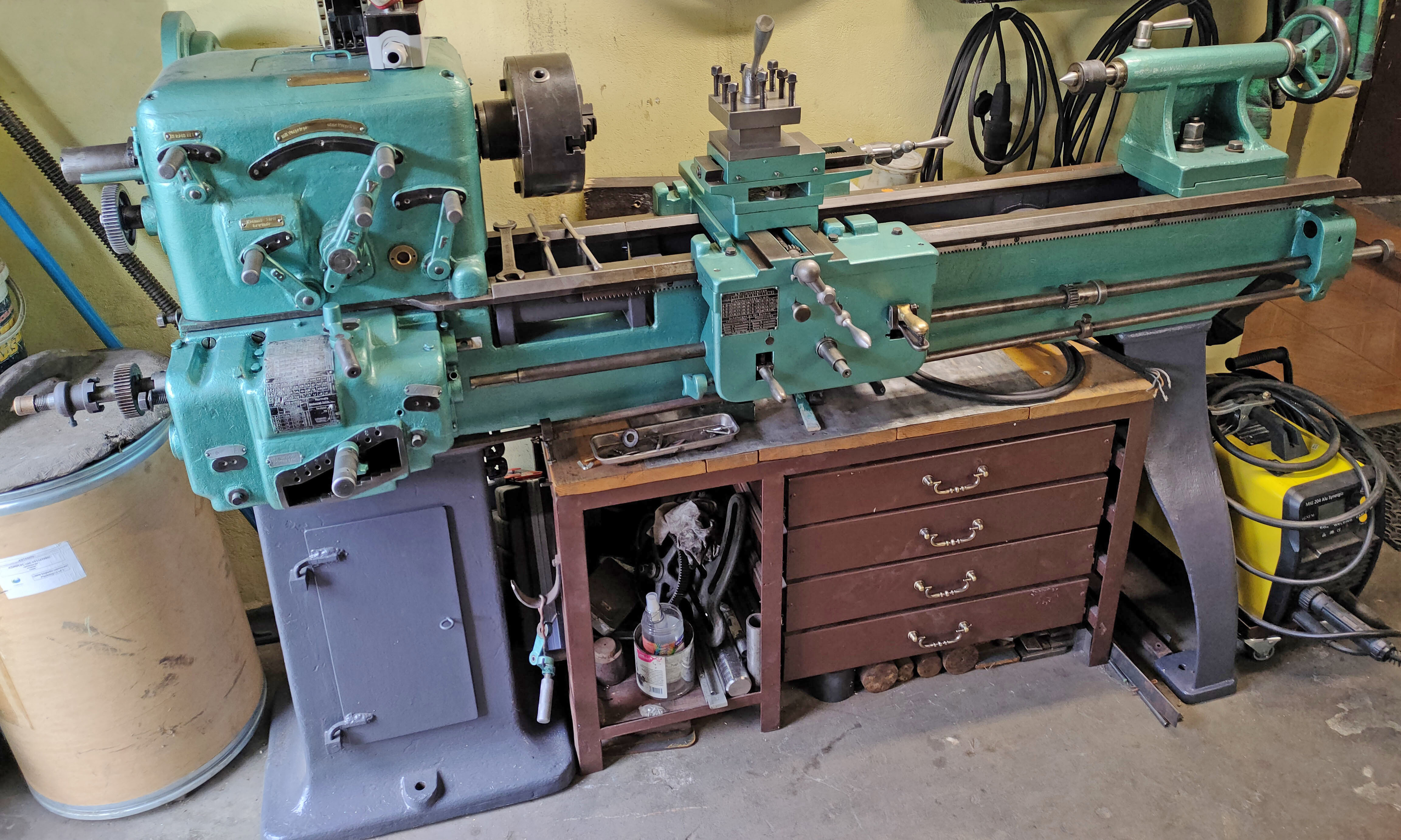
Unknown outside its native France, the watchmakers' lathe by Outillerie, 137 Boulevard de Magenta, Paris, was of the heavier WW (Webster Whitcombe Type), though with a 60 mm centre height, one of the few such lathes to venture outside the usual 50 mm limit. Hence, this was a heavy-duty lathe, able to take 200 mm between centres and fitted as standard with a compound slide rest and a 4-way toolpost. In this configuration, it might just be included in the class of plain-turning bench-precision type, as begun by the American Company Stark in 1862.
Advertised at 45,000 francs, the Outillerie de la Loire lathe would almost certainly have been less expensive than the more common offerings from German and Swiss makers such as Boley, Lorch, and Favorite. The Company's advertisement claimed the lathe was "Brought within the means of amateurs at the exceptional price of 45,00 francs" These would have been 'old francs', the new franc (nouveau franc, NF) being on 1 January 1960 to counter the hyper inflation of the 1950s that had made everyday prices run into thousands of francs. Hence, it's likely the lathe was current during the 1950s. It was described as "all-steel", a term not dissimilar to that of the more common "all-hard", a stamping often found on cheap copies of high-class watch and clockmaker's lathes.
In the United Kingdom, the 45,00F that would have been around £46, a sum that represented just over five weeks' average industrial wages in 1955. In inflation terms, to January 2026, when the average weekly wage was £742, that would be £1500 - but in terms of purchasing power (a much more accurate measure), more like £3,700-£3,800.
In its basic form, a watchmaker's lathe is of little use for many of the processes employed when making or repairing watches, and all the established makers offered various sizes of fitted boxes holding a variety of useful accessories. One wonders whether the maker was able to offer these items, many of which required high-precision manufacture and were consequently expensive. Common amongst these items would have been a countershaft drive system, headstock collets, tailstock runners, a compound screw-feed slide rest (as included with the Loire), a flip-up T-tool rest, a filing rest in single or double-roller type, a drill chuck for the tailstock use, drilling plates (a disc with a ring of holes each formed with a coned face to self-centre work), a drive or catch plate and a set of drive dogs for turning work between centres, a Jacot Drum, a dividing or indexing attachment to mount on the headstock spindle or a milling slide and perhaps fixed steady and travelling steadies, though the latter is rarely employed on a watch lathe).
|
|