|
If you're used to driving a turbo-diesel or large-capacity modern petrol car, it's not unusual for an Austin 7 engine to sound and feel as though it's revving hard. The reality is more sobering: in ordinary use, with standard gearing, wheels, and speeds rarely reaching 50 m.p.h., the revs rarely rise above 3000 r.p.m. in top gear.
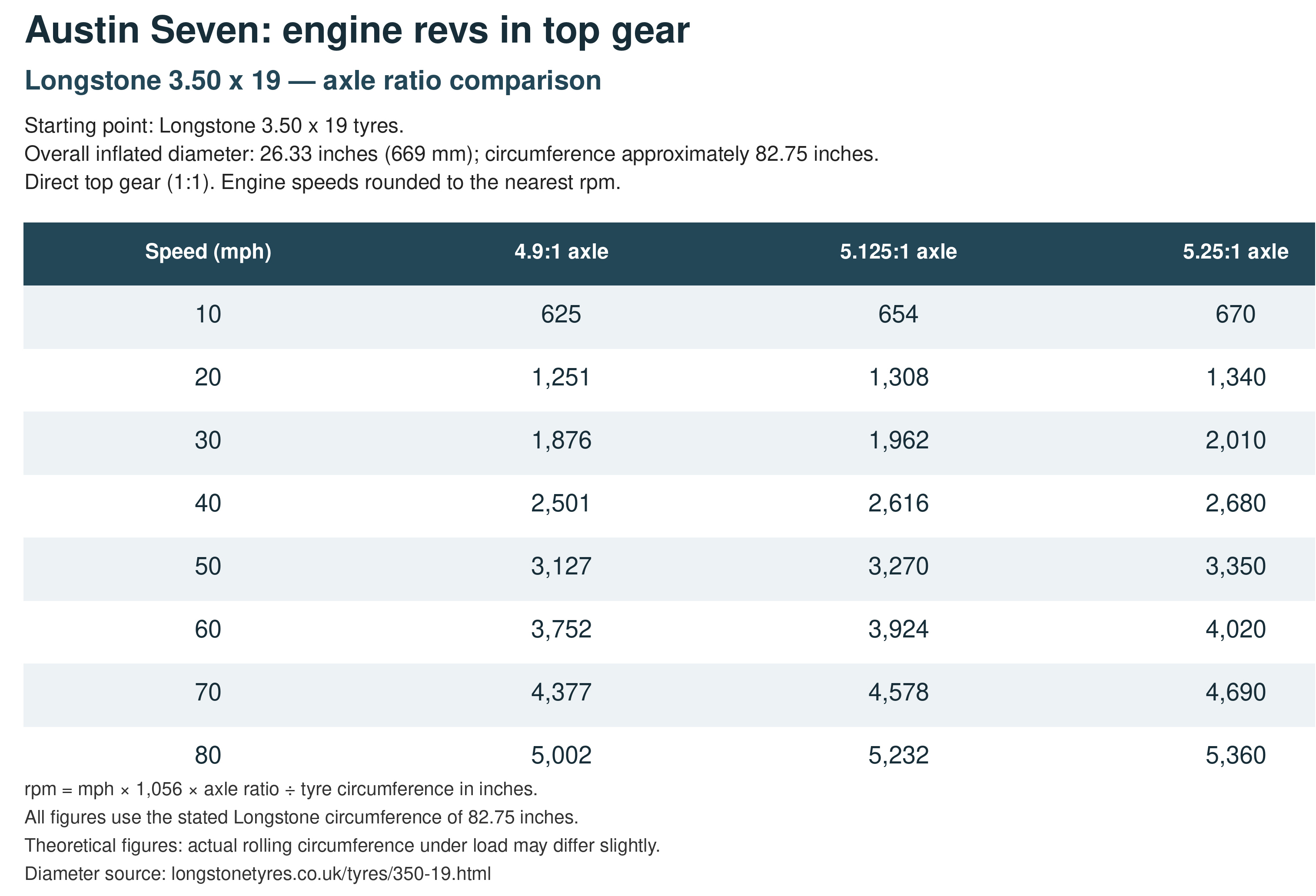
The first chart shows the engine revs achieved by a typical Seven, with a 4.9, 5.125 and 5.25 back axle and 3.30 x 19 tyres.
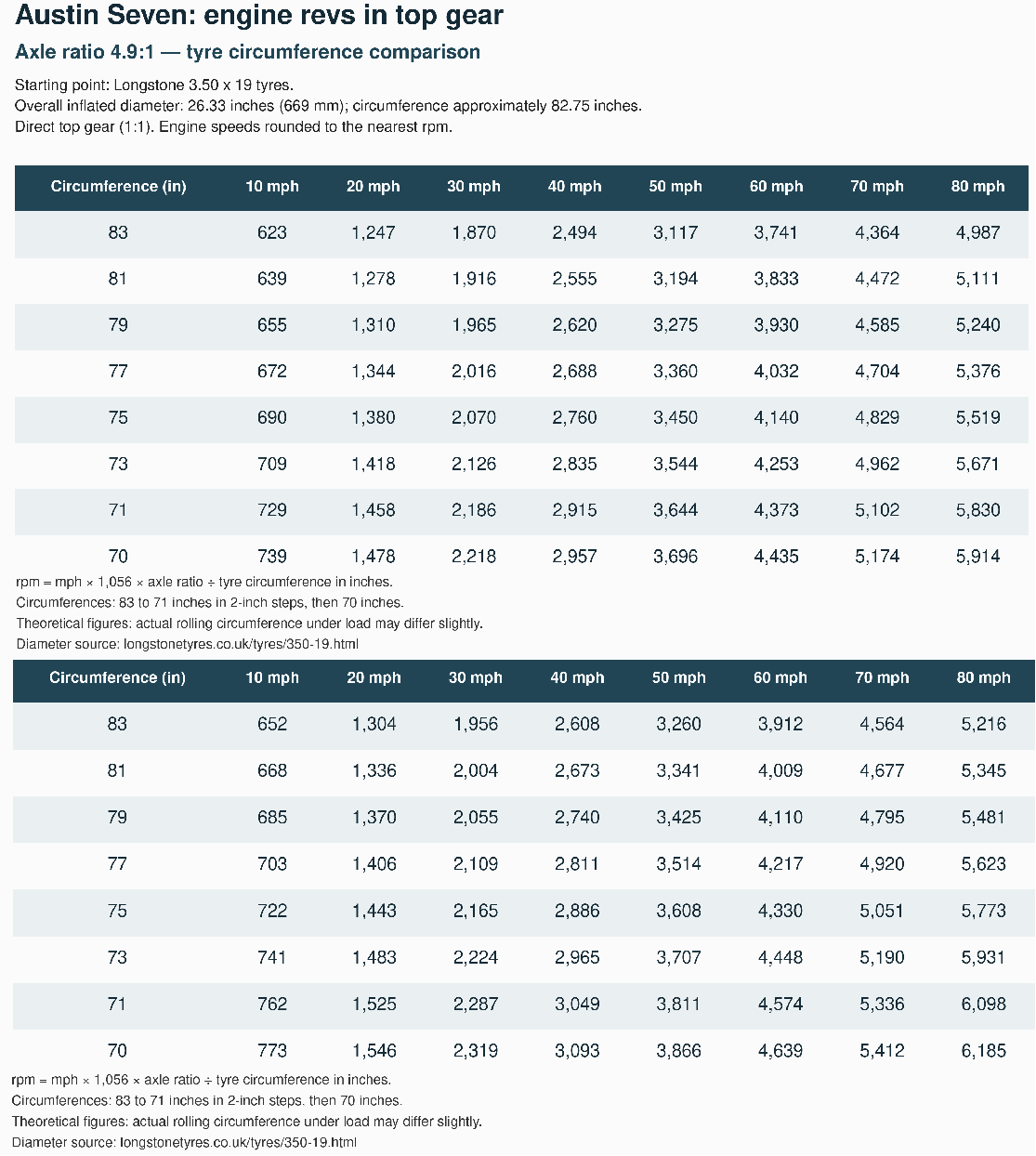
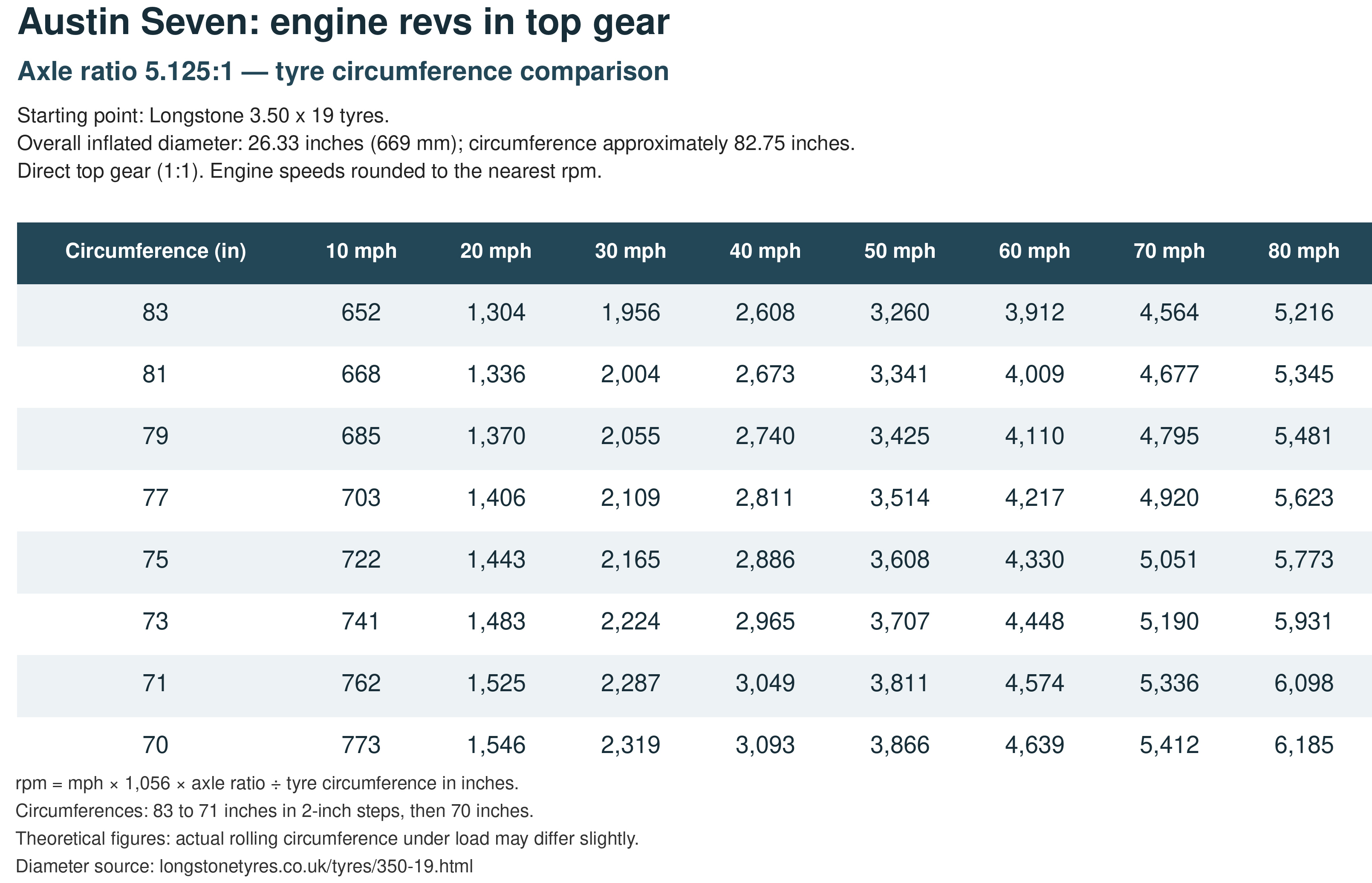
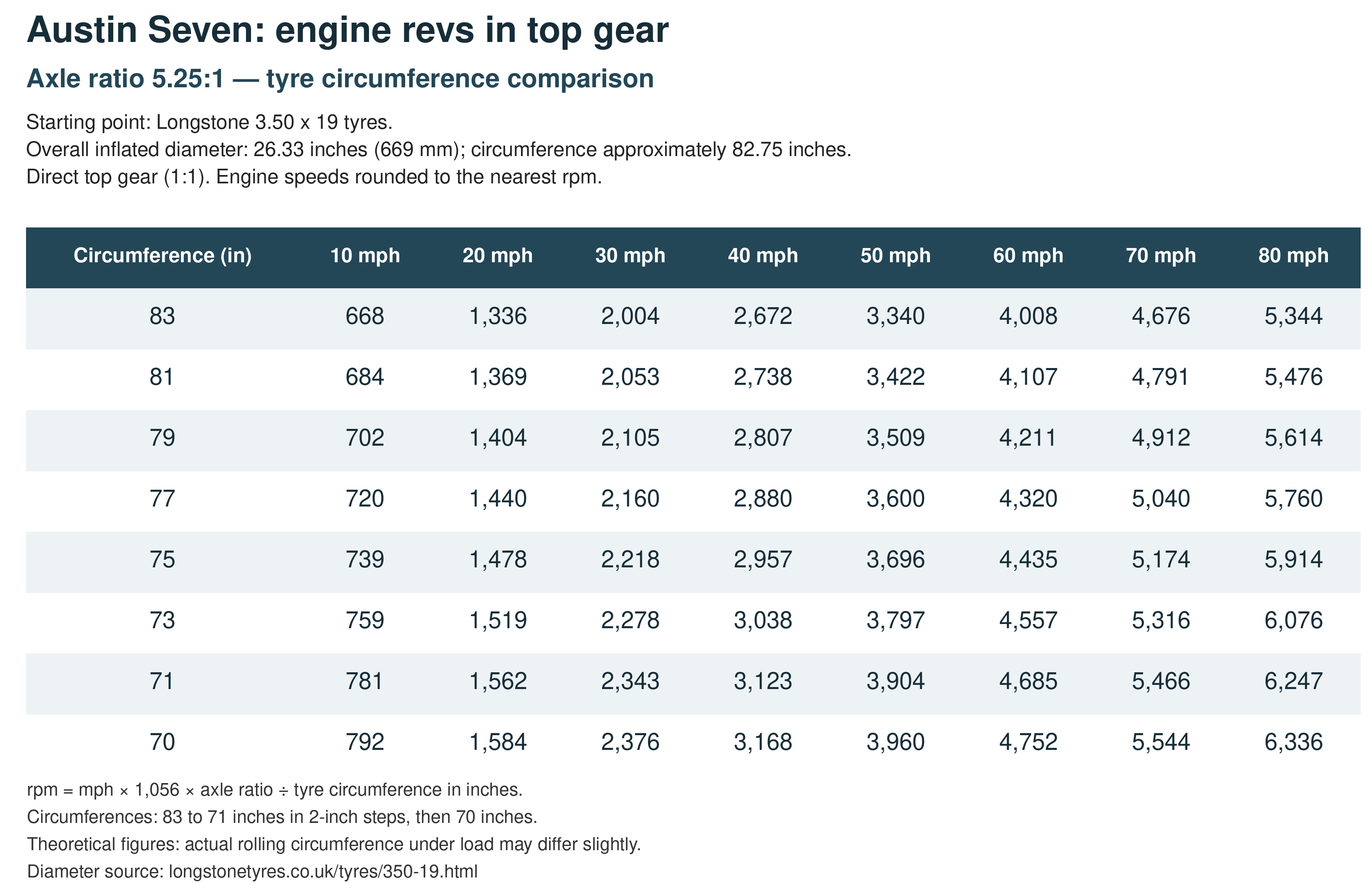
The following charts expand to list the revs achieved with tyres of different circumference, the starting point being 83 inches, just above the 82.75" of a standard 3.30 x 19, and going on to 70", which if about the circumference of a 15" rim fitted with a 4.5 or 5" tyre might be.
Of course, you need to measure your tyres' rolling circumference carefully and, if you have a different-ratio back axle, use the following description to calculate it yourself.
The charts use the following formula for top gear, where the gearbox turns the propeller shaft once for every turn of the engine (as it does in an A7):
Engine rpm = (speed in mph × 1,056 × axle ratio) ÷ tyre circumference in inches
Where does 1,056 come from?
There are 63,360 inches in a mile and 60 minutes in an hour:
63,360 ÷ 60 = 1,056
Therefore, multiplying mph by 1,056 gives the distance travelled in inches per minute.
First, measure how far the wheel travels in one turn.
Chalk a mark on the tyre and a corresponding mark on the road. Roll the car forwards until the tyre has made exactly one complete turn, then mark the road again. Measure the distance between the road marks. This is the tyre's rolling circumference. For greater accuracy, measure over five complete revolutions and divide the total distance by five. Do this with the tyres correctly inflated and the car carrying its normal load.
Next, divide the distance travelled each minute by the tyre's rolling circumference. This tells us how many complete turns the wheels make each minute.
Finally, multiply the wheel revs by the axle ratio. With a 4.9:1 axle, the propeller shaft turns 4.9 times for every complete turn of the rear wheels. In direct top gear, which the Seven has, the engine turns at the same speed as the propeller shaft.
An example at 40 mph
For the first chart, I used the stated approximate circumference of 82.75 inches for the Longstone 3.50 × 19 tyre.
Distance travelled each minute:
40 × 1,056 = 42,240 inches
Wheel turns each minute:
42,240 ÷ 82.75 ˜ 510.45 rpm (˜ means approximately, or in this case, near enough...)
Engine turns each minute with a 4.9:1 axle:
510.45 × 4.9 ˜ 2,501 rpm
Changing to a 5.25:1 axle, while keeping the same tyres and road speed, gives approximately 2,680 rpm. The higher 'numerical' axle ratio (oddly, we call that a lower-axle ratio) makes the engine turn more times for each wheel turn.
To work backwards from engine revs to road speed, rearrange the formula:
Speed in mph = (engine rpm × tyre circumference in inches) ÷ (1,056 × axle ratio)
The charts give, of course, theoretical figures based on the stated tyre circumference. For the closest match to the actual car, use its measured rolling circumference. The charts use 4.9 exactly; the familiar 44-tooth crown wheel and 9-tooth pinion give an actual ratio of 4.8889:1--a very small difference. I've no idea how much a 3.50 x 19 tyre expands at 80 mph....
|
|